This is a work of fiction.
It starts with a… no, it doesn’t start with anything. Nature, or more precisely the nature of us, cannot be sharpened to pinpoints of causality. That is not the way of things. The way of things is blunt sunlight, it is wobbly driving rain, it is an accidental wind tunnel made of decagenarian brick facades, it is interdependence gradually sparking into consciousness, which is the origin story of bureaucracy, it is a horizontally-bound thing having the audacity to live in a vertically-driven world, and it is the ever-changing speed at which the complex navigates the simple.
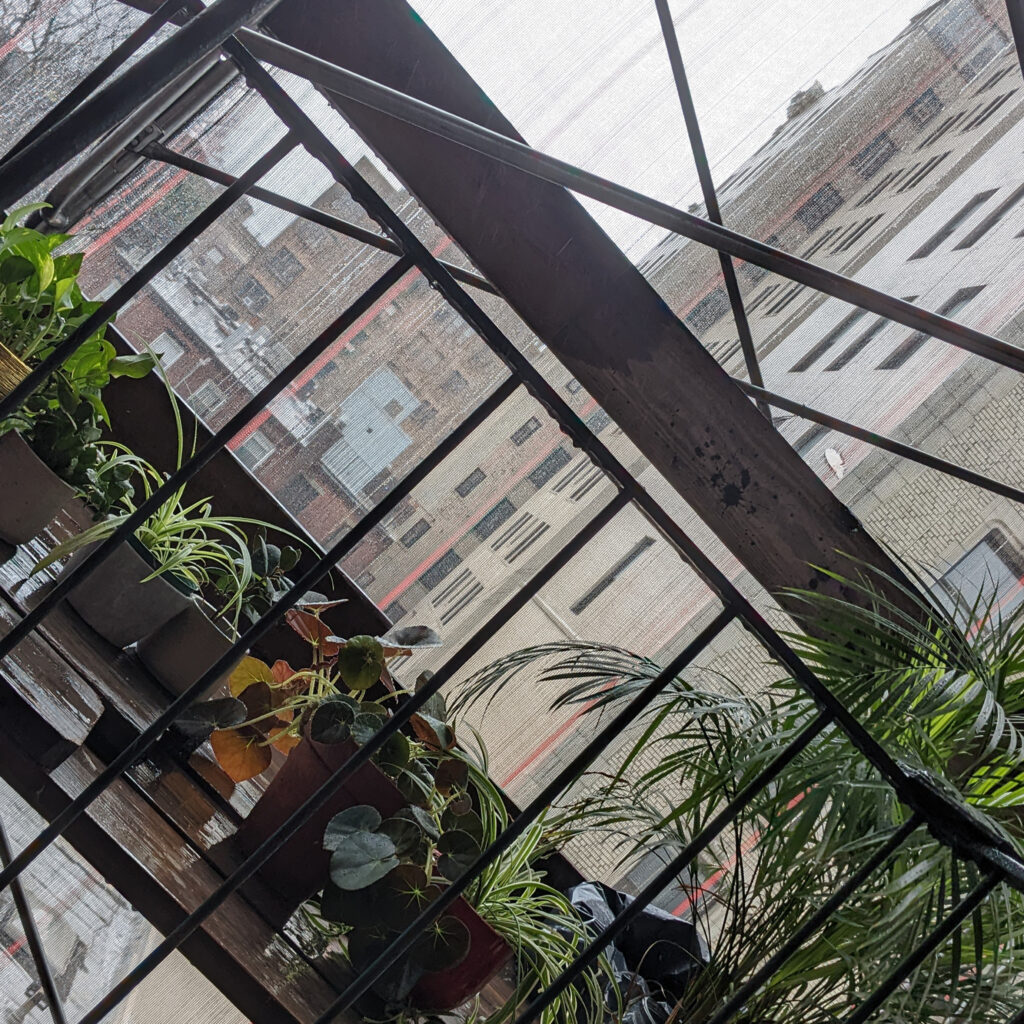
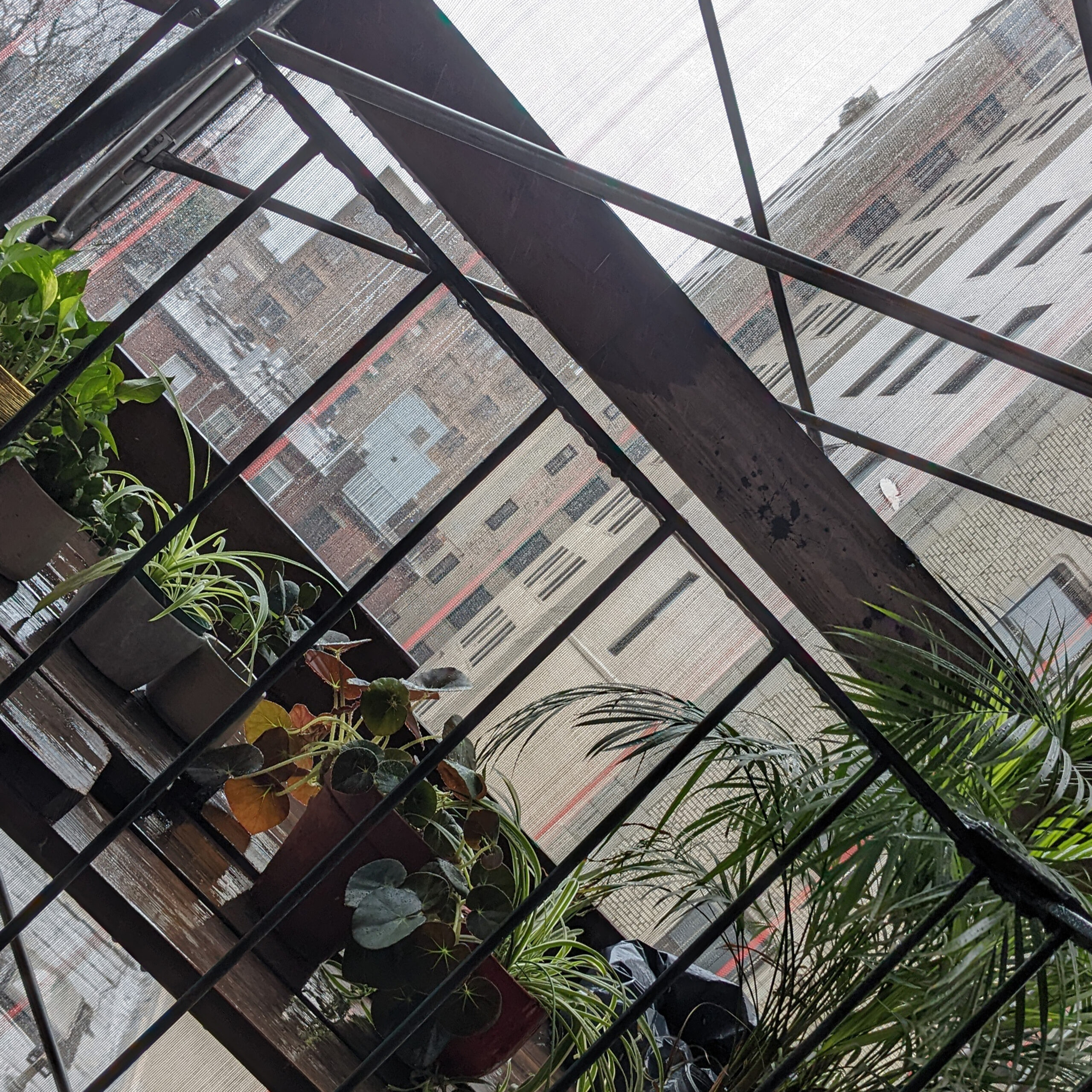
Sometimes as I trickle through a typical day, I catch myself. “I wonder what mischief the rest of the world is up to right now? Who is getting arrested? What votes are getting wrangled to advance that petition? What tree celebrated its 500th birthday? Who just dropped their driver’s license in a crowded place?” How are these questions conceived? In my case, I was staring out of my living room window, through the scrim of a scaffold.
The rain had started early but never matured into a downpour. Through the saturated troposphere, the dirty window, and two layers of polyethylene, the light on my face was feeble, making me want to rub my eyes. On the glass I caught a smudged self-portrait of myself and my city. I had a day job in data analytics, Bagel (who only responds to factoids, maxims, haikus, or circumcised proverbs), and twenty houseplants and counting. We were all dormant or dying, like seeds buried in wet soil, unsure whether we’d germinate. How many seeds in the state of New York are germinating at this very moment? How old will the person who was just born this second grow to be?
The scaffold had been erected a few months earlier for the regular Local Law 11 facade inspection of our Civil War-era building. What began in the city as an earnest campaign to protect innocent heads from cracking under fallen bricks had become, in less than a decade, a derisive shorthand for bureaucratic overreach. Like a letter from an undead relative clamoring for their share of an inheritance, our co-op dreaded receiving the notice from the Department of Buildings every five years, knowing it would mean another $50,000 hole in our operating budget and another six months, no less, shrouded under a pipe-and-plank scaffold. My plants would grow spindly and wilt, dust would sneak through the panes of our double-hung windows and settle onto our breakfast plates, Bagel and my neighbors’ dogs would go crazy, we would greet each other in the elevator with hung heads, without the same joy of coming home after work. It was like we were all in mourning. Mourning something that hadn’t yet died, stuck, exasperated to the point of laughter.
I had to break free. How do clowns break free from the circus, or plants from the pot?
A glint from the street below sparked a thought in my mind. I looked at Grace. Suddenly it hit me– today was our 10th anniversary. I still hadn’t gotten her a present. I quickly pulled a bag of soil from my closet, mixed it with snowy speckles of vermiculite, gently filled the empty nooks of the pot, and set her back on the windowsill. I tried to imagine fresh nutrients now rushing into her roots and suctioning up her stalks. But she deserved more. Just because I was resigned to gloom didn’t mean she had to be.
I opened the window, clambered out onto the fire escape, and set her down on the scaffold planks just behind a tarp-covered mound of scrap materials. Most of them were spare construction materials for the facade renovation that hadn’t been touched in weeks: small stacks of bricks, a couple coils of wire, hangers, clamps, and leftover lengths of wooden plank and schedule 40 pipe. A pair of unopened Poland Spring bottles, latex-coated gloves, a scratched hard hat, and a plastic bag full of crumpled foil sandwich wrappers gave the mass a hint of domesticity, a collage of a living room, shared between the construction worker who ate his lunches and I who watched the sunsets. In the exact spot where Grace now sat, a column of water gently dripped down from the level above.
Let her golden fronds be my calendar. I can’t see the sun from my living room anyway. I took a photo of her with my phone, committing to memory the approximate length of her five tendrils now creeping imperceptibly outward. How many feet equate to how many months living under a scaffold? How long do I wait, how long do I grow?
Out here, no dimness, no smudged windows, though the light still filtered through the black scrim, it is all around. A light for all times of the day. Accompanying it, air, so fresh and sharp and pungent that it carries sounds in it, tickling the trichomes and penetrating the skin. The immense gentleness of wood grain on the underside of my limbs, the pressure of the damp soil, every object outside a fiber of muscle pulling me this way and that, toward the shallow pools and the sunspots, my most sensitive parts cradled into existence by ancient waves of radioactive decay.
If you weigh the effort of moving horizontally or vertically, the city is as tall as it is wide. But it is also diagonal. Rays of delicious sunlight stream through the air, their blue waves beckoning my stem to reach out. Everything is either up and out or over and out. Like a thing spreading its arms in a dramatic gesture, at some point it cannot spread them any wider and so must retract. But I can grow more arms, more related fingers, to keep alive my elated sarcastic exhausted embrace. The pressure of the planks, in particular the narrow gap between each, edges serrated with splinters, guide me forward. It is by their presence that I know where the absence, the out, is. I touch pools of water hidden among the human materials. Droplets on the underside of metal flanges, ready to fall into the precipice. Skinny ponds drawing themselves like filaments through gaps in dead wood that no longer absorbs them. Cardboard sheets as wet as soil.
The following day, her leaves have all about-faced toward the sun’s path. Three days after that, white marbling becomes visible on them. Three days after that, she is six leaves denser, looking unlike herself. By the height of spring, she has grown to three times her length. I stop staring so much out the window, so I stop noticing or caring whether the contractors are showing up to work. Maybe the summer deadline has made them lazy. Maybe there truly is only one factory left in the northeast New World that can still fabricate true terra cotta for them. Maybe they are enthralled with the brilliance of this year’s spring like me, and have forgotten about bricks. But Grace hasn’t. Her arms are extending down over the front edge of the wooden walking surface, toward the floors below. Other arms have cleverly snuck around the back of the tarp and are already touching the facade. One arm has even found a pipe post and has audaciously begun to curl around it, climbing.
I keep an eye out for the inevitable concerned neighbors’ emails about getting my plants under control, but they never come. Instead, more rains. The board may have delayed the work. On my way home from Key Food I pause, looking up at the building from across the street. Grace is smaller from here than from inside my apartment, but still bigger than I expected. I hear a voice behind me say “Vaya”. Turning around, I see Stella the plant shop owner muttering, “Look, that is how long the scaffold has been up. Even the plants are protesting.”
My non-plan is going according to plan.
Simultaneously, I remember the past and the future. Grace Gold, whom I never knew, is walking home on a raw day such as this, talking to her friends, directly beneath me, a brick, a distant cousin. Spring has done a number on me, the warm wet air washing my jacket of mortar away and allowing me to loosen. I don’t choose to fall, exactly, although staying is deeply uncomfortable. No, I think, this building doesn’t want me anymore. I let go. As I fall, I wish I were made up of cellulose instead, that way I would land gently. But Grace is not thinking that. I do not know what her last thoughts are. In a delicate balance, her loss of consciousness sparks a new consciousness to life, in the form of a New York law. Then my remains are dispassionately trucked off to a scrapyard in Queens, ground down, mixed with soil, resold, and now cradling the roots of Grace the ivy, remembering Grace the human girl.
I also wonder how many tons of pipe and plank have been made and moved since that night five decades ago. And now that the city’s architects have rallied and redesigned them, will anyone miss the silver pipes?
I grow conscious of different shades of space and time. Data illuminating realities I hadn’t previously known. There are 2,822 buildings in New York City that have plants growing on their facades. This number has declined steadily over the past several decades. 860,381,144 seeds germinating at this moment across the nurseries, balconies, gardens, and forests in the state of New York. The height of this building and the width of Montague Street in millimeters. One and a half sextillion water molecules suspended in a drop of water. The minute circumference of a photon. Over the course of a day, the many different colors of the sun.
It’s time. I creep out of my suffocating pot and, hardening my roots’ outer cells, I stand up. Careful to avoid being seen, I walk to the fire escape. More quenching rains come and go, the pulsating pressure of the wind makes me believe I can hear, and suddenly I realize that the humans have long gone. Brooklyn sits abandoned, all its achingly straight lines and impermeable surfaces left behind by their makers. Perhaps they went to space. They had been talking about it long enough. There’s a deer on the asphalt below, guiding her babies toward the Promenade. The scaffold will protect her. Whether she’s a tourist or a native, she’ll catch herself, look up, and see a telltale old-growth building: gnarled, patchy, splintering, clay-fired and cracking like it had been made in a kiln, and always a hedera helix camping over the entire southern half of the facade.
This place needs a redesign.